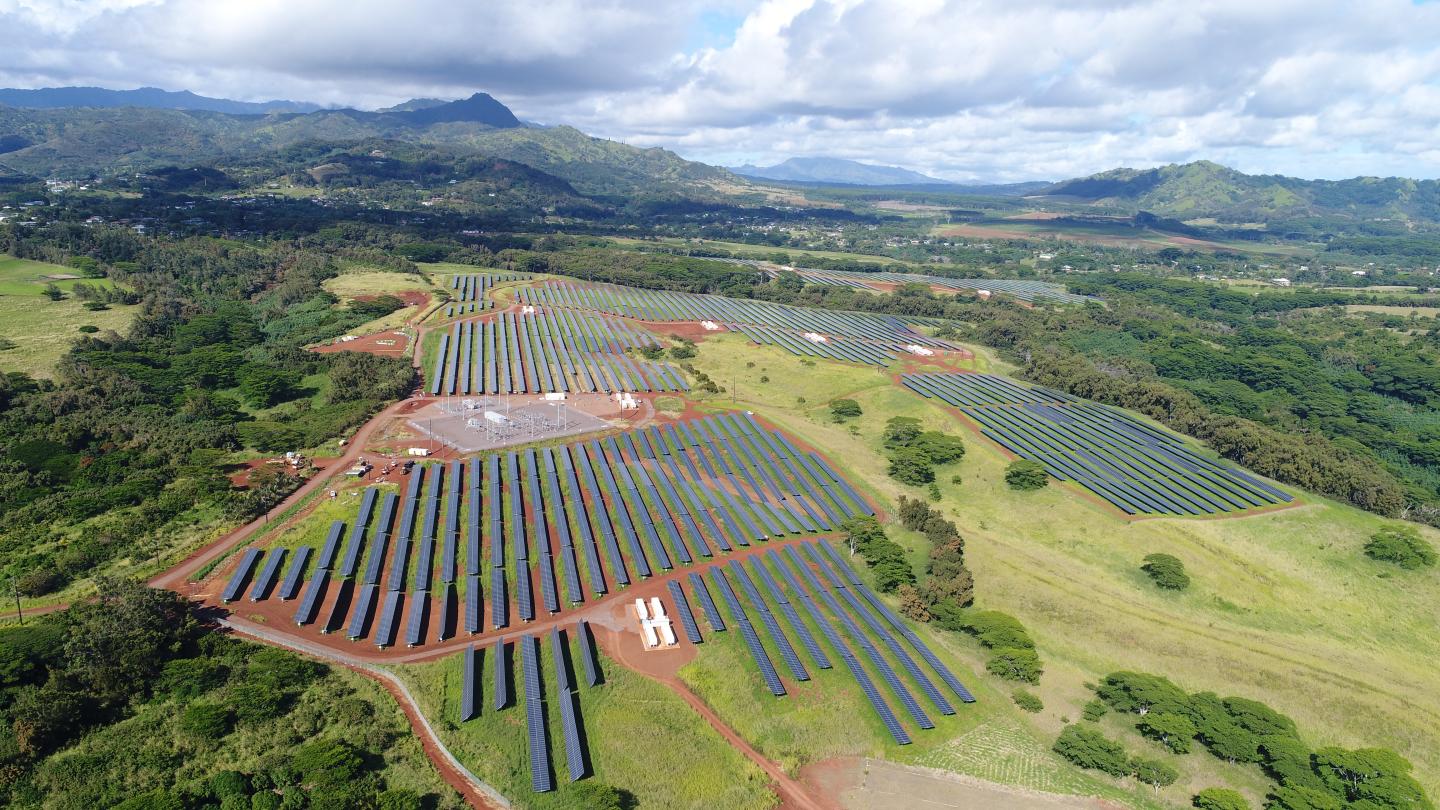
KIUC Among the Highest in State in Renewable Generation for 2025
From KIUC, May 20th, 2026
Kauaʻi Island Utility Cooperative (KIUC) achieved a 52.8% Renewable Portfolio Standard (RPS) for 2025, second highest in the state behind Hawai‘i Island. KIUC continues to be well ahead of the State of Hawaiʻi requirement of 40% renewable by 2030, and on track to meet the mandated 100% renewable by 2045.
2025 Renewable Generation Breakdown
The 52.8% for 2025 was reported to the Hawaiʻi Public Utilities Commission (PUC) in KIUC’s annual RPS filing. The 2025 performance represents a slight increase over 2024, a growth driven primarily by stronger performance from the Mahipapa biomass facility. Utility-scale solar contributed 24.5% of KIUC’s generation in 2023, with 14.3% generated from members’ rooftop systems. Other renewables contributing in 2025 were hydropower (9%) and biomass (5%).
Member Savings and Rate Stabilization
KIUC’s high percentage of renewable generation has helped to stabilize rates, with KIUC consistently posting the lowest, or among the lowest, rates in the state since May 2022. “Our renewable energy is purchased under fixed-price power purchase agreements, which helps buffer our rates from the volatility of global oil pricing,” said KIUC’s President and Chief Executive Officer, David Bissell.
Five utility-scale solar projects placed into service since 2014 have been the main impetus for Kaua‘i’s RPS progress. KIUC’s Chief of Operations Brad Rockwell points out the value of this renewable transition is most acutely felt when oil prices increase sharply, as has been the case for the past few months. “Without those large solar projects, we estimate the average KIUC residential bill would have been $41 higher this month alone.”
Meeting Strategic Goals
KIUC’s Board of Directors has set a strategic goal of reaching 100% renewable by 2033; a full 12 years ahead of the State of Hawai‘i mandate. If two new renewable projects currently under development are delivered into service as proposed, KIUC could be approaching 90% renewable by 2030.
More information on KIUC’s strategic goals can be found on the cooperative’s website: www.kiuc.coop/strategic-plan.
* * * * *
Additional New Kaua’i Renewable Energy Project Earns PUC Approval
News Release from KIUC, May 14th, 2026
The Hawai‘i Public Utilities Commission (PUC) has approved a power purchase agreement (PPA) for a second new solar-plus-storage project on Kauaʻi. If successfully developed, AES’ Mānā Solar + Storage project, coupled with AES’ previously approved Kaawanui Solar project, would bring Kaua‘i to nearly 90% renewable generation by 2030.
“We’re grateful to the PUC for the timely approval so these projects can move forward and attempt to capture available incentive tax credits that will expire at the end of 2029,” said KIUC’s President and Chief Executive Officer, David Bissell. “The PUC approvals could not have happened without the support of the Consumer Advocate, Kaua‘i’s state legislative delegation and the Kaua‘i Mayor’s office.”
AES’ Mānā Solar + Storage project is a proposed 35-megawatt (MW) facility with 4-hour storage capacity that would produce an average of 86,000 megawatt hours (MWh) annually of dispatchable renewable energy over the 25-year PPA. The project would be located on land owned by the Agribusiness Development Corporation (ADC) on the Mānā Plain. If brought to fruition, the Mānā project would displace the use of 5.9 million gallons of diesel per year.
Coupled with AES’ Kaawanui Solar, located on land owned by Robinson Family Partners and managed by Gay & Robinson, Inc., the two projects are expected to save members at least $13.4 million in the first year of operation, with a total savings over the 25-year PPA term of roughly $800 million.
“With these projects in operation, Kauai ratepayers will have much less exposure to cost spikes, as we are now encountering, from volatile fossil fuel,” said Bissell. “If they were in service today, our average residential member would be paying about $27 less for their electricity in May.”
In total, the projects would account for 35-40% of KIUC’s annual energy production and would power more than 30,000 homes.
Each project will include a component of compatible agriculture. AES Hawai‘i expects to partner with local, Kauaʻi-based companies who bring deep expertise in land stewardship and sustainable practices and will co-locate agricultural activities on the sites.
“The PUC’s approval of Mānā Solar + Storage, together with its previous approval of Kaawanui Solar, are significant milestones that will enable AES and KIUC to continue delivering on their shared goal for clean, reliable energy for Kaua‘i,” said Nick Molinari, Senior Director of Development, AES. “We are grateful for the continued partnership with KIUC as we work together to support Kaua‘i’s renewable energy goals, and we look forward to working with the governmental agencies, stakeholders, and community toward securing the remaining approvals needed for the Mānā project to move forward.”
The Mānā and Kaawanui projects would be the third and fourth renewable energy projects developed by AES Hawai‘i for KIUC. In 2019, AES and KIUC made history together by bringing online the Lāwa‘i Solar + Storage Project, which was the largest operational solar and energy storage system in the world at the time. In 2021, in collaboration with the U.S. Navy, AES’ Kekaha Solar + Storage project, also known as the AES PMRF Project, was placed into service.
* * * * *
April 23, 2026: KIUC to Retire $2.7 Million in Patronage Capital to Members | Kauaʻi Island Utility Cooperative